
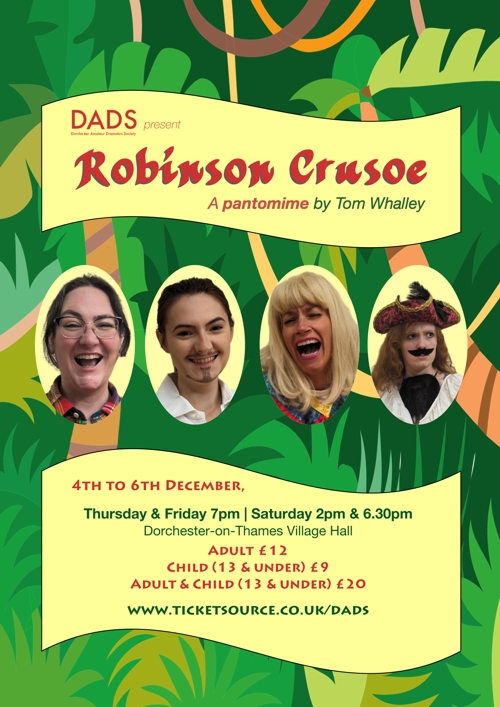
 Robinson Crusoe Review
Reprinted from Dorchester News February 2026
I have to confess, when I first heard that this winter’s pantomime would be Robinson Crusoe, I questioned how such a story—originally published in 1719 and famously centered on just Crusoe and Friday—could be adapted for the stage. My concerns were unfounded. Tom Whalley, whose pantos DADS has successfully staged before, wrote this version with apparently no reference at all to Defoe’s classic. It was also reassuring to learn that the first pantomime adaptation appeared as early as 1796 at Theatre Royal, Drury Lane, so there’s a rich tradition of adapting this tale for festive fun.
In this production, Robinson (played by Alice Hope) is one of two sons of Captain Crusoe (played by Mark Williams), alongside Sprat (Lucinda Kendrick); their mother is Dame (just in case you weren’t sure) Crystal Crusoe (Rachel Winslet—who, for the second consecutive year, brought a female flair to the traditional dame role). The family runs a fish and chip shop in Widdling by the Sea.
The plot thickens when the villainous Blacktashe (Roisin Barnfather), aided by sidekick Winkle (Jack O’Brien), appears seeking a map believed to be in the Crusoe’s possession, pointing the way to hidden treasure on a distant island. After discovering the map in their shop, the Crusoes set sail—unaware that Blacktashe has snuck aboard in disguise and later steals the map on the island.
Among the crew is the stowaway Polly Perkins (Hayley Poole), an 18-year-old in love with Robinson. In the final showdown, her hotel-keeper father Peter Perkins (Stuart Poole) shows up, and is revealed to be an old pirate himself. Together, father and daughter help save the day and the treasure, leading Robinson to propose to Polly—how else could it end?
And as for Friday? This time, Friday (Sally Bell) is a native islander who becomes both the family’s guide to the treasure and the show’s narrator, having never met Robinson before.
The audience could tell the show would be entertaining from the first glimpse of the set. Designed by Adrian Brooks, Simon Clements, and the team, it conjured up the spirit of Donald McGill seaside postcards: saucy humour, bold colours, and the sign ‘Widdling by the Sea.’
The performance sparkled thanks to Calypso (Ann Winslet) as fairy godmother and the unstoppable energy of Liz Ramage and James Pratt, who seemed to appear in so many disguises — from crew to birds to monkeys — that It was difficult to keep count.
But the real standouts were the four women at centre stage. Rachel Winslet, as Dame Crystal, lit up the room with unmatched charisma and a stunning costume crafted by Elaine Williams which captured her character perfectly. This was Rachel at her very best.
Alice Hope (Robinson) and Lucinda Kendrick (Sprat)—both seasoned and versatile DADS actors—played off each other brilliantly as the sensible Crusoe brother and the other one.
Roisin Barnfather, a newer addition to the group, who made her first DADS appearance just a year ago, has a strong stage presence and made a memorable impression as the fearsome Blacktashe—she certainly made me affeared of Blacktashe’s evil intentions..
Everyone could sing, delivering everything from rousing numbers to softer songs, all under the guidance of Ian Salisbury on keyboard who also musically set the scenes —and held props as necessary.
Several scenes stood out, like the hilarious Desert Island Discs gag, the new recipe routine and a coconut-dropping ‘truth coconut tree,’ played by an uncredited Jane Brooks, which pelted anyone who fibbed with coconuts (to much comic effect and the detriment of the Captain’s head). Even changing positions didn’t help as the coconuts continues to rain down on the poor Captain.
Director Russell Bailey’s decision to limit scene changes to just one during the interval, kept things moving, ensuring nonstop action, laughs, and pantomime mischief from start to finish. And the cast clearly enjoyed the production as much as the audience did.
Congratulations to everyone involved – it was a thoroughly enjoyable show, and now I’ll never doubt that even a classic can make for a fantastic panto.
Ian Brace
*Fun fact: 150 years later, Offenbach adapted the pantomime into a comic opera, giving it an extra dose of theatrical pedigree.*
*************************************************************************************************
Robinson Crusoe Review
Reprinted from ODN February 2026
Dorchester Amateur Dramatics Society’s Robinson Crusoe tackled one of the familiar challenges of village pantomime head-on: how to create a sense of scale, adventure and variety on a small, wingless stage that must be built afresh each time. What followed was a creative, energetic and warmly received production that made smart choices and played confidently to its strengths.
The presentation made excellent use of limited space. A simple but effective painted seaside backdrop remained in place throughout, with smaller scenic pieces brought on in front to establish each location — from deckchairs and pier elements in Widdling by the Sea to palm trees and beach debris on the desert island. This approach worked particularly well, keeping the stage uncluttered while allowing plenty of room for the cast to move. The decision to use the foyer for entrances and exits was inspired, especially the memorable barrow entrance wheeling the Dame on stage, which delighted the audience.
Costumes were bright, colourful and clearly thought through. The Dame’s apron emblazoned with “Catch of the Day” was a lovely, characterful touch that neatly referenced the family fish and chip shop. Overall, costumes and make-up were well judged and helped define each character clearly. One small practical issue was Friday’s sunhat, which obscured her face a little; a minor adjustment here would have made her character even more effective. Lighting and sound effects were effective throughout with cues well timed. Given the technical limitations of the hall, Simon Ratliff did an admirable job supporting the storytelling without distraction.
Direction by Russell Bailey was assured, and the cast displayed plenty of confidence throughout which was nice to see for an opening night. Entrances and exits were confident and well timed, and the director clearly paid attention to grouping the cast carefully — essential on such a compact stage. Despite the numbers involved in some of the scenes, the stage never felt overcrowded. Scene transitions were slick, though there may have been scope to develop the ensemble clean-up routine further to add an extra layer of visual interest.
Performance-wise, the cast threw themselves into the piece with enthusiasm, and several standout roles shone brightly. Roisin Barnfather was superb as the villainous Captain Blacktashe, exuberant and commanding, maintaining a gravelly pirate voice throughout and working the audience with great confidence. Rachel Winslet-Morris delivered a wonderful female Dame: saucy, quirky and blessed with excellent comic timing, expressive facial work and strong vocals. Alice Hope brought warmth and lightness to Robinson Crusoe, making her an engaging Principal Boy whom the audience could easily root for. Lucinda Kenrick grew nicely into the role of Sprat, starting a little quietly but gaining confidence and delivering some excellent comic moments — not least a very well-handled “better bit of butter” routine — alongside sparkling audience interaction. Mark Williams’ Captain Crusoe proved a strong foil for the Dame, with the coconut scene standing out as an especially enjoyable pairing.
Dorchester are fortunate to have pianist Ian Salisbury providing excellent live musical accompaniment, and his responsiveness to the onstage action made him feel like an extra member of the cast. The musical selection was well chosen and varied, with numbers including Mr Blue Sky, Drunken Sailor, Go West, Reach for the Stars, Islands in the Stream and a particularly enjoyable A Professional Pirate from the pirate ensemble. The community song Hot To Go was enthusiastically received, and Step into Christmas provided a festive close. Choreography was kept simple and accessible; while it occasionally looked a little chaotic, the cast made it their own.
Comic routines were plentiful and well judged. The bum-wiggle dance to frighten the baddies was a huge hit, the desert island disc routine was neatly executed, and the falling coconuts gag raised plenty of laughs, even if a slightly brisker pace might have sharpened it further.
I’ve seen a few Tom Whalley pantomimes before, but I thought this was a cracking script delivered with confidence, creativity and clear enjoyment by Dorchester Amateur Dramatics Society. Packed with comic moments, good team work and buoyed by an enthusiastic cast, who clearly know what their audience likes. A thoroughly enjoyable pantomime that sent everyone home smiling.